
WHAT WAS REALLY ON THE PALETTE
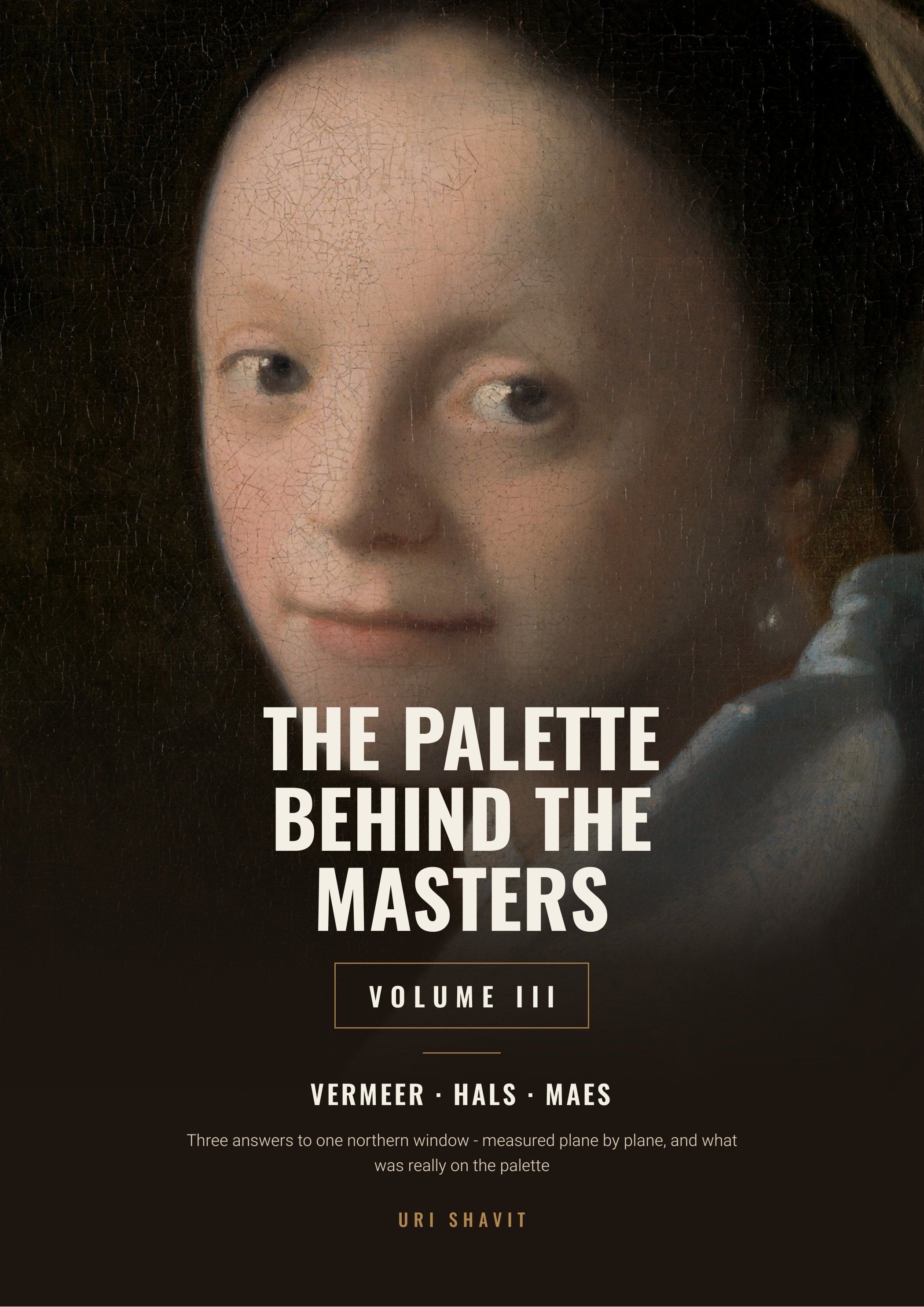
THE EXACT SKIN TONES INSIDE A VERMEER, A HALS, AND A MAES
This book measures the flesh in a masterpiece exactly as it survives today, and sets out, from published conservation research, what the painter actually had on his palette. Those are not the same thing - and the gap between them is the most interesting part of the book.
$19.95
Instant PDF download
1
See the finished painting
2
Get the exact mixes I used to paint it
3
Mix them yourself at your easel
THIS IS NOT COLOR THEORY
It is the palette behind three Dutch masters, opened up two ways: what the canvas measures today, and what conservation research says was on the palette. Vermeer in Delft, Hals in Haarlem, Maes in Amsterdam and Dordrecht - three decades of the same low northern daylight, read the same way. Where the record is thin, the plate says so.
WHAT IS INSIDE
- 3 MASTERPIECES FROM THE METROPOLITAN MUSEUM - Vermeer's Study of a Young Woman, Hals's Portrait of a Man, face and fist, and Maes's Young Woman Peeling Apples.
- 36 FLESH READINGS IN TOTAL - 10 to 14 per painting, each one a literal pixel sampled inside a hand-drawn mask so nothing lands on a collar, a curl, a crack or an impasto ridge.
- WHAT IS ON THE CANVAS NOW, AND WHAT WAS ON THE PALETTE THEN - kept on separate pages, with the evidence named on every plate, including the one canvas no technical study has ever examined.
- THE SAME TEN TUBES AS THE OTHER VOLUMES - no specialist colors, and one honest loss named up front: lead white, which Titanium White can only stand in for.
- TWO KNOBS, MEASURED APART - Vermeer's face never rises past 38 percent saturation, the quietest of all nine paintings in the series so far; Maes's working hands reach 61, the highest in this book, on a tighter hue than either.
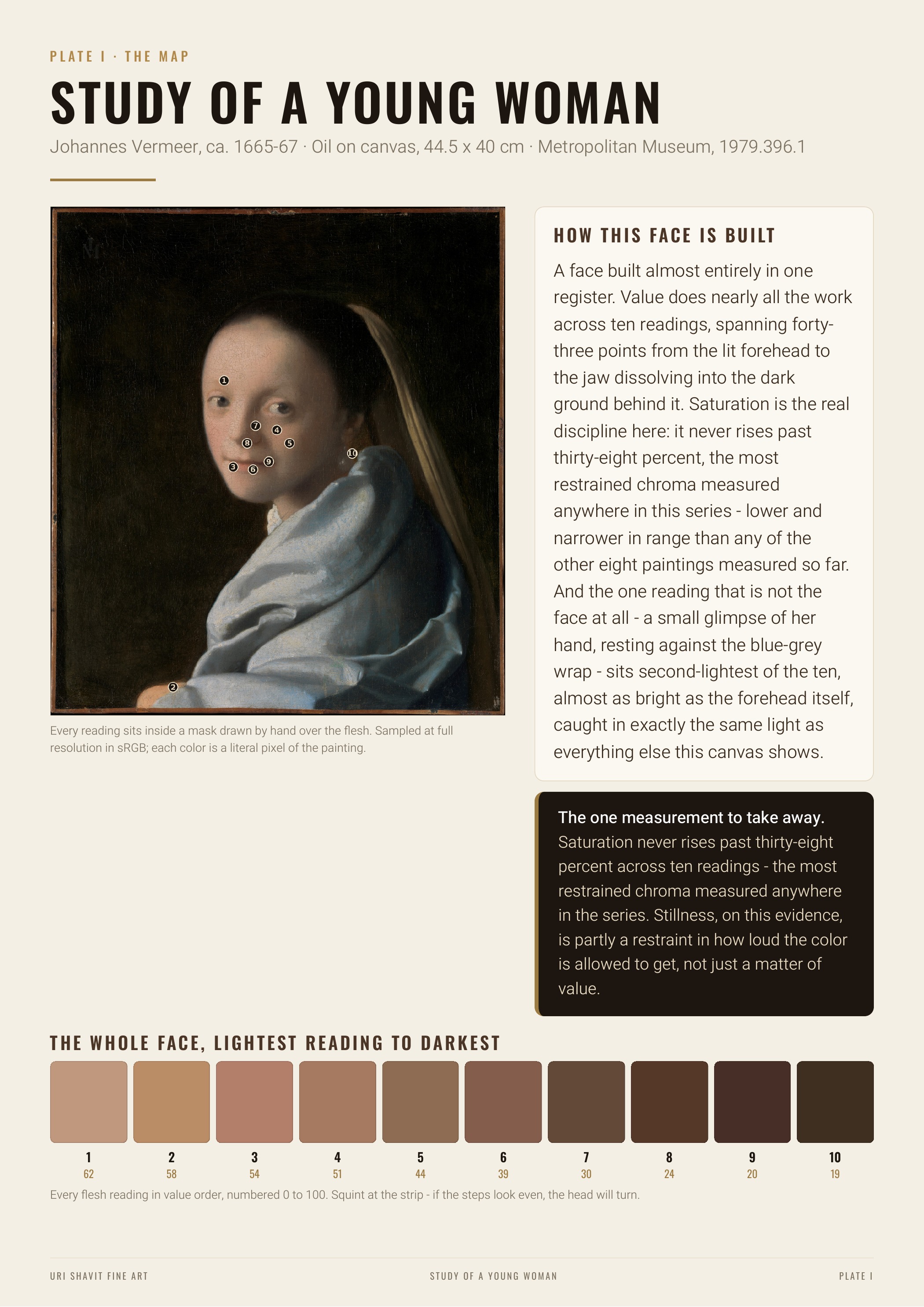
THE MAP - WHERE EVERY READING WAS TAKEN
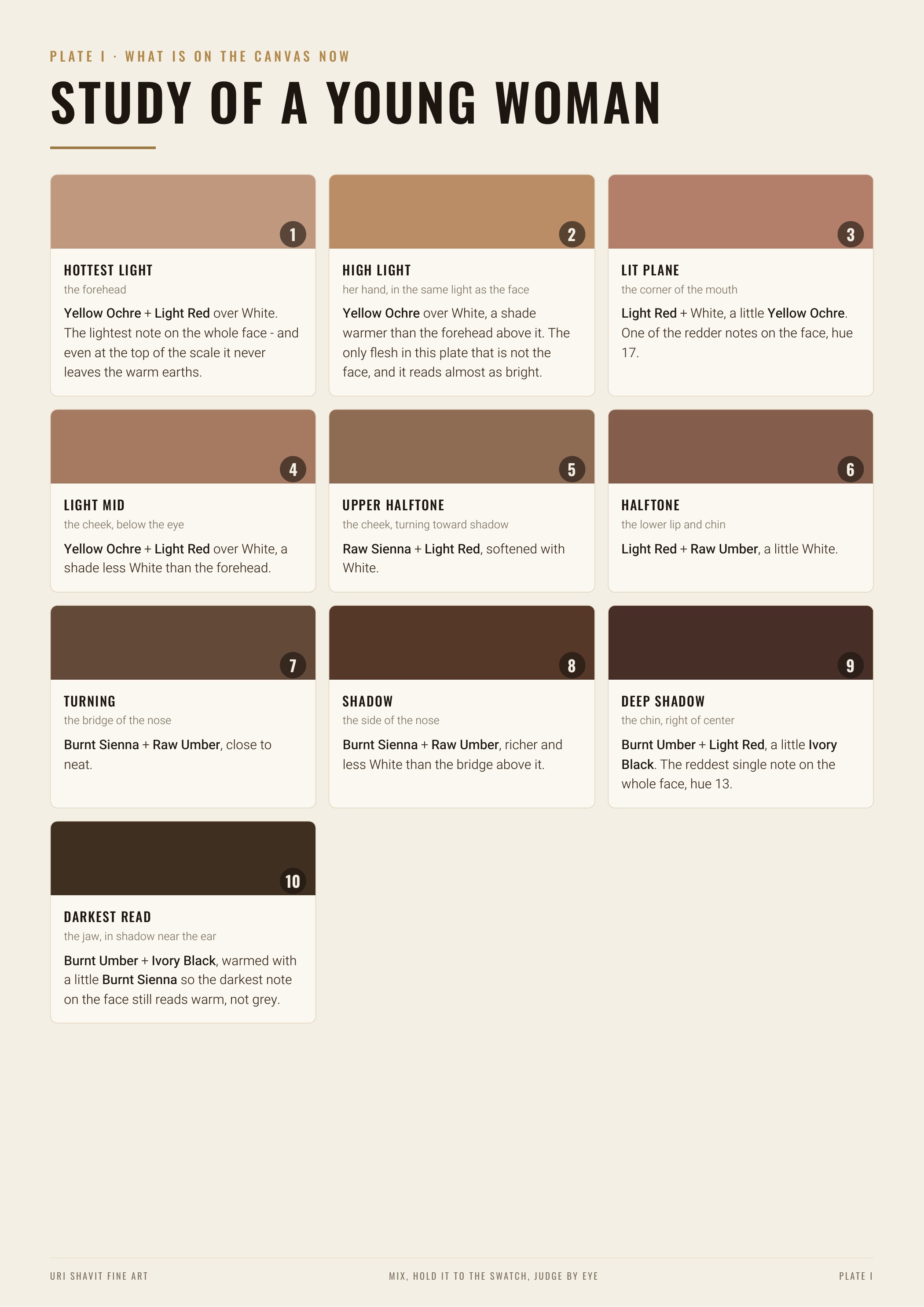
ON THE CANVAS NOW - TEN READINGS, TEN MIXES
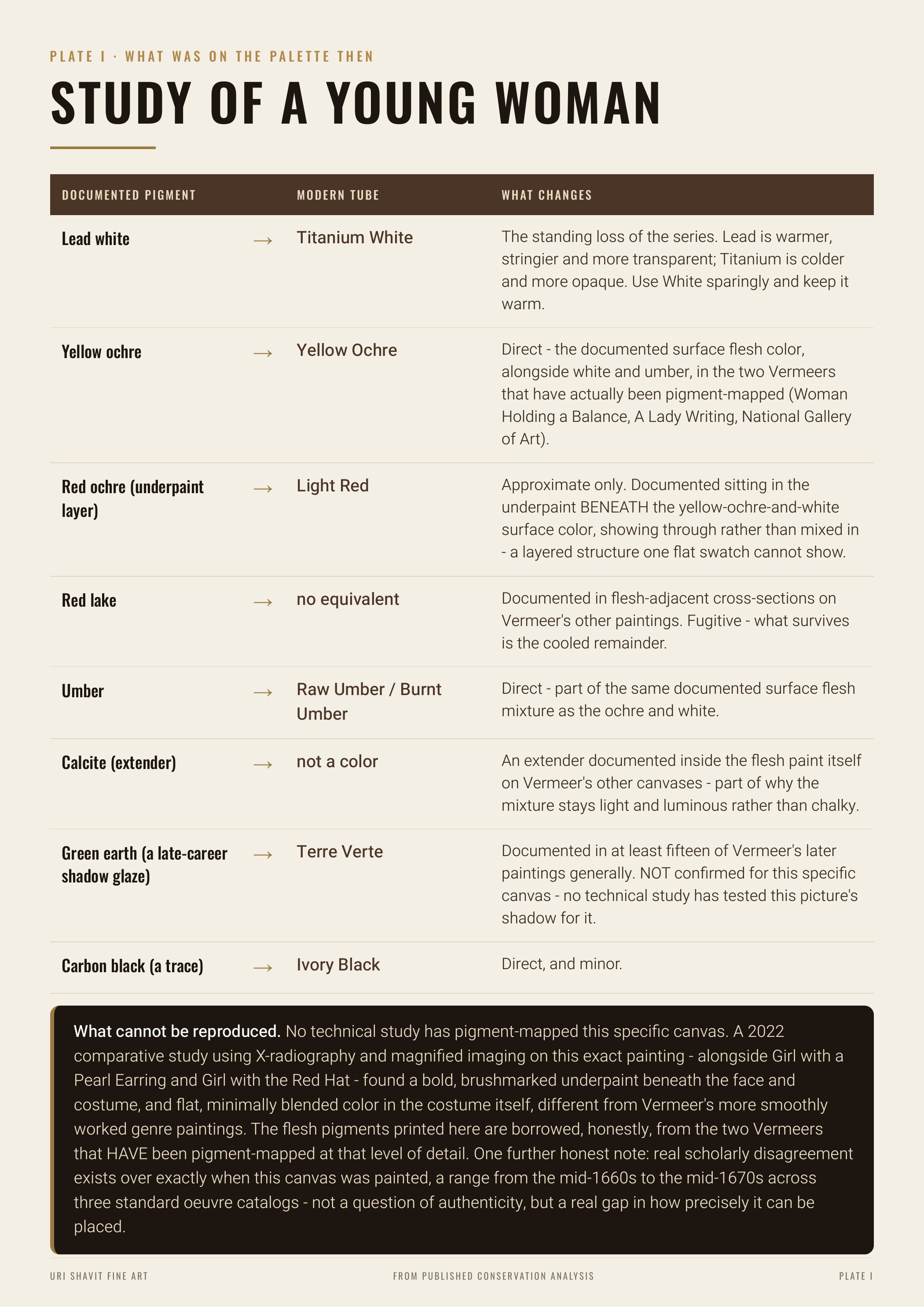
ON THE PALETTE THEN - THE DOCUMENTED PIGMENTS
WHO IS IT FOR
For the painter who has looked at a Vermeer face and wondered how something that quiet can feel so alive. If you want to know what is really in it - measured on the canvas, then checked against what the technical record can and cannot say - this is that answer, with the gaps marked.
WHY TRUST IT
I am Uri Shavit, a classically trained oil painter. For over twenty years I have taught color - to a YouTube community of more than 134,000 painters and in my own studio. Every color in this book is a literal pixel of the painting, sampled inside a mask I drew by hand. Every pigment claim is cross-referenced with published research - twenty sources, cited at the end of the book - and where a canvas has never been tested, the plate says so in plain words.
Not a single flesh reading in this book is cool. Thirty-six here, on top of eighty-two across the two earlier volumes: one hundred and eighteen readings, nine painters, and every one falls in the warm quadrant.
QUESTIONS
DO I NEED THE OTHER VOLUMES?
No. Each volume stands on its own. This is the third Masters volume - the Portrait volumes open up my own paintings; the Masters volumes open up the museum's.
WILL IT ACTUALLY HELP MY PAINTINGS?
Yes, if your flesh goes gray or dead as it turns into shadow. As these three canvases survive today, all thirty-six readings stay warm from the lightest note to the darkest - what changes is value, and how saturated the color is allowed to get. Where the record shows a master reaching for a cooling pigment in shadow, the plate says so.
HOW ACCURATE ARE THE PIGMENT CLAIMS?
Every pigment table is cross-referenced with published research - twenty sources across the three painters, cited at the end of the book. Treat it as an informed, documented reading, not a certified restoration report. None of these three canvases has been fully pigment-mapped, so each plate names where its evidence comes from, and the Maes plate says plainly that no technical study of that painting has ever been published.
WHAT PAINTS DO I NEED?
The same ten tubes as the other volumes (Michael Harding and Winsor & Newton, Series 1), or any comparable oils. The one substitution that hurts is lead white, and every plate notes what else is lost in the swap.
WHAT FORMAT IS IT?
A downloadable PDF, designed for a computer or iPad screen, not a phone. Instant download after purchase.
CAN I PRINT IT OR SHARE IT?
Print it for your own studio use. It is a personal-use license, so please do not redistribute or resell. The three paintings themselves are public domain under the Metropolitan Museum's Open Access programme.