
Cadmium Yellow: Why Your Lights Fall Flat (And How to Fix It)

The most powerful yellow on your palette is also the easiest to misuse - here is what it actually does in oil, and the three mixes that make skin glow.
The myth that started this conversation
People say you should add white to make your lights lighter. It is the most natural instinct in the world - light means pale, pale means white, so you reach for titanium white and pile it on. What you get is a chalky, flat highlight that sits on the skin like a sticker. The light looks applied, not felt.
The real problem is not the white. It is the missing warmth. Sunlight is not white. It is warm. And the pigment that carries that warmth most directly - in oil, at full opacity, without going chalky - is cadmium yellow. Once you understand what cadmium yellow actually does in a mixture, the idea of a white highlight starts to feel like a category error.
That is what this post is about. Not hype, not theory. Just what the pigment is, what it does well, where it fails, and the three mixes that will actually change your lights.
What cadmium yellow actually is
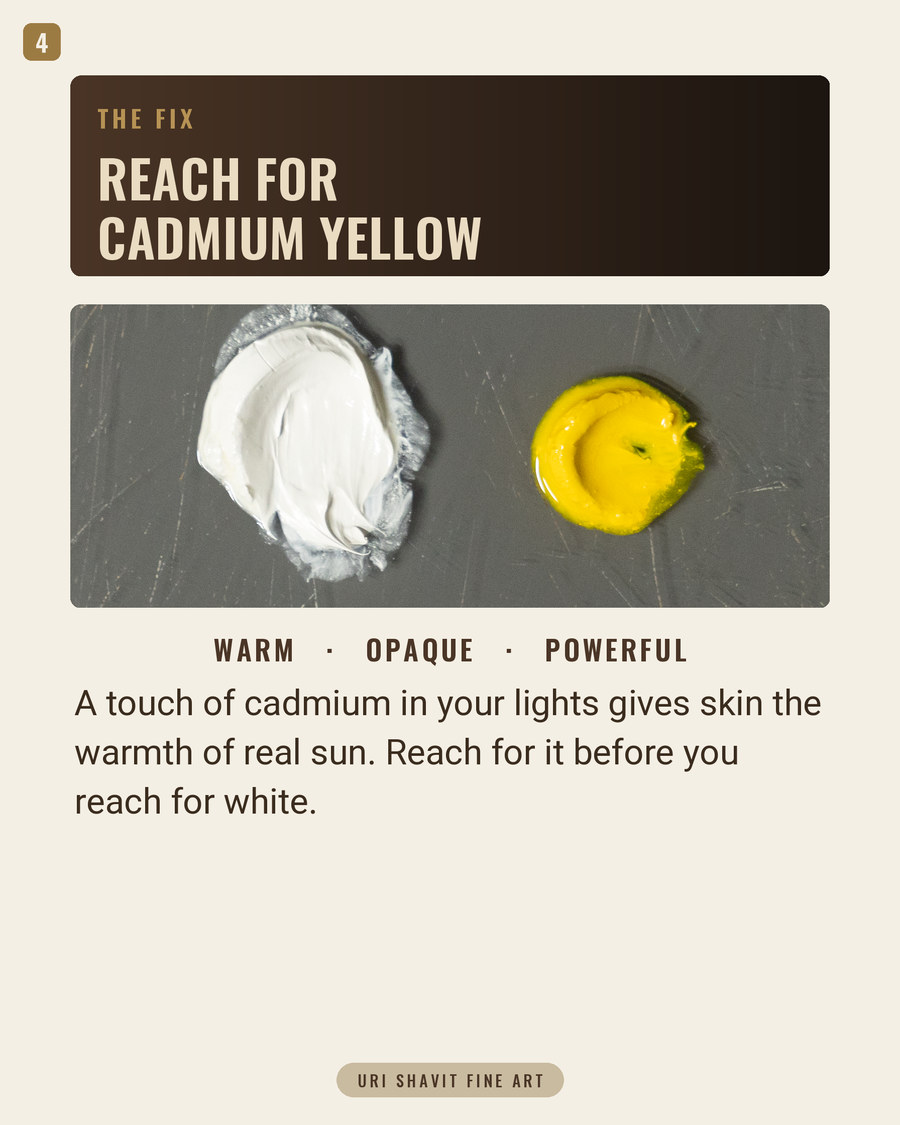
Light shades of cadmium yellow are cadmium zinc sulfide (CdS combined with ZnS), Color Index PY35. Deep shades are pure cadmium sulfide (CdS), listed as PY37. The zinc content in the lighter version - up to around 25% - pushes the hue toward a greenish lemon-yellow. Increase the cadmium sulfide and you move through a warm primary yellow toward a deep orange-yellow.
Cadmium sulfide is a semiconductor. Its bandgap sits at 2.42 eV, which means it absorbs blue, indigo, and violet light; your eye perceives the complement as yellow. That is not paint-counter poetry, it is the physics behind why cadmium yellow looks so saturated and why it holds its chroma even in thick, opaque passages.
In oil, this pigment is fully opaque and rated Lightfastness I under ASTM D4302 - the top grade. Its oil absorption is moderate (around 21.8 grams of linseed oil per 100 grams of pigment), which means it dries at a moderate rate and stays workable. Its tinting strength is extremely high. That last point matters more than anything else on this list, and I will come back to it in the failure modes section.
The historical thread
Cadmium yellow is a strictly modern pigment. Cadmium was discovered in 1817 by Friedrich Strohmeyer in Germany, who identified cadmium sulfide as a potential yellow almost immediately - but commercial production did not begin until roughly the 1840s, when cadmium became available as a by-product of industrial zinc refining. Before that, it simply did not exist.
This means that every brilliant warm yellow in a painting made before the mid-19th century was made with something else: yellow ochre, lead-tin yellow, orpiment (arsenic trisulfide), Naples yellow, or - from around 1809 onward - chrome yellow. For warm glazes, painters used gamboge. When you look at a Rembrandt and admire a glowing warm light, cadmium had nothing to do with it.
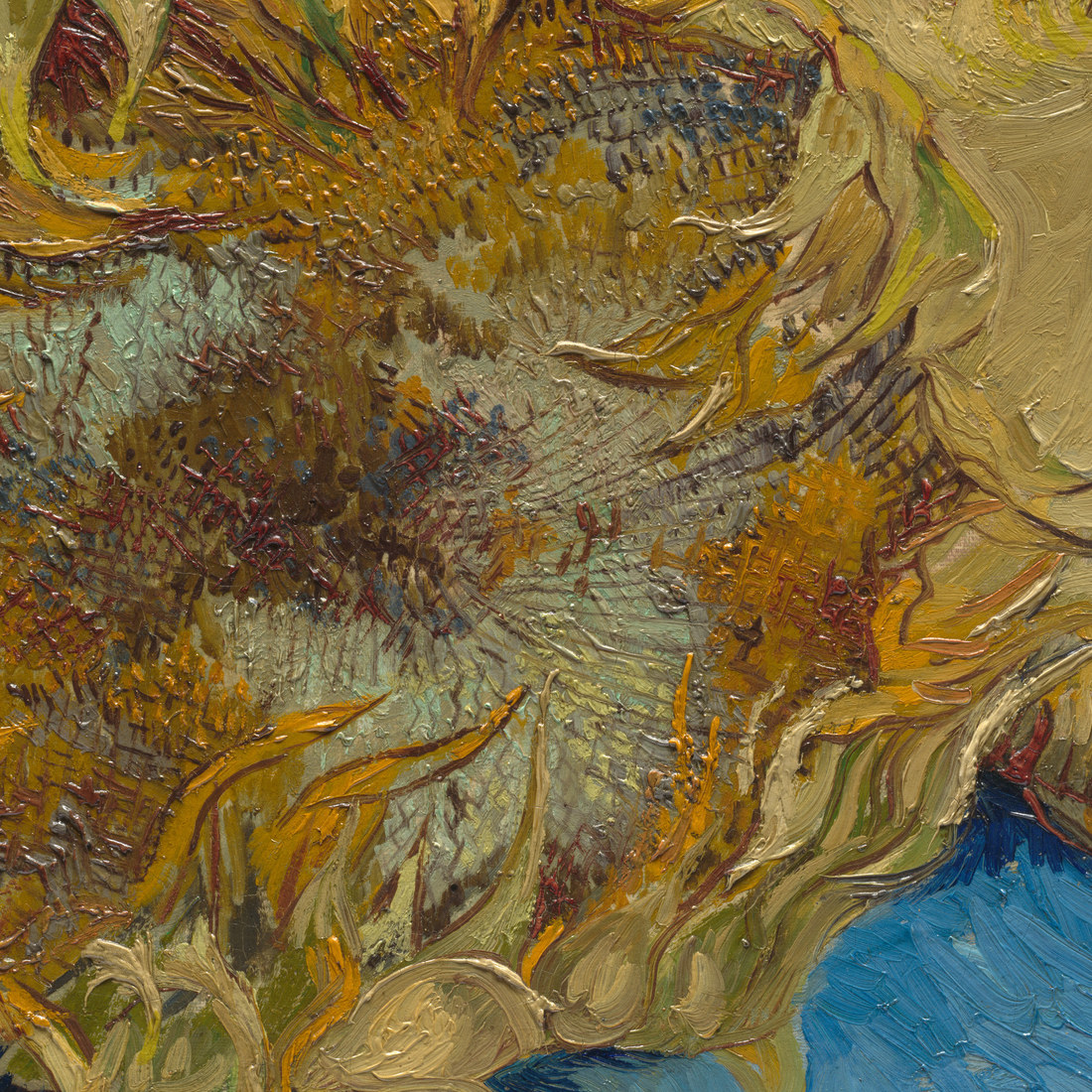
Cadmium yellow's rise replaced chrome yellow among the Impressionists and Post-Impressionists. It was more expensive, but painters accepted that because it offered higher chroma and greater chemical stability. Monet, Cézanne, Matisse, and Van Gogh all used it. Van Gogh mixed cadmium yellow and vermilion to build the bright orange passages in his sunflowers. The warmth in those paintings is not an accident of technique - it is cadmium sulfide absorbing violet light.
One historical footnote worth knowing: in the 1920s, cadmium pigments were co-precipitated with barium sulfate to produce cheaper cadmium lithopone. These were less permanent than pure cadmium yellows. Some of the documented fading and surface-crust formation in works by Van Gogh, Matisse, Munch, and Ensor traces to those earlier formulations - mixtures of different crystalline phases that were less stable than the modern h-CdS or ZnxCd1-xS pigments in your tube today.
The failure modes
Buying a hue and treating it as genuine cadmium. A tube labelled "Cadmium Yellow Hue" is typically a semi-transparent arylide (Hansa) yellow - Color Index PY3 or similar - rated Lightfastness II rather than I. It is not opaque. Its tinting strength is lower. It behaves differently in layering and in mixtures, and it will fade faster on a painting meant to last. The hue tube is not a bad product, but it is a different product. Using it as a straight swap and wondering why your highlights look thin is a gap between assumption and chemistry.
Underestimating tinting strength. This is the one I see most often. Cadmium yellow has very high tinting strength. If you dose it the way you dose a transparent organic yellow - a generous squeeze mixed loosely into white - you will either get oversaturated, chalky results or blow past the warmth you wanted and land in something acidic. A tiny amount goes a long way. Start with less than you think, and add slowly.
Mixing it with copper-based pigments. Cadmium yellow cannot be safely mixed with verdigris, malachite, or any pigment carrying reactive copper. The copper reacts with the sulfide and the result is discoloration. This is not a theoretical concern - historical sources flag it directly. If your palette includes any copper-based green, keep cadmium yellow away from it.
The three mixes that matter
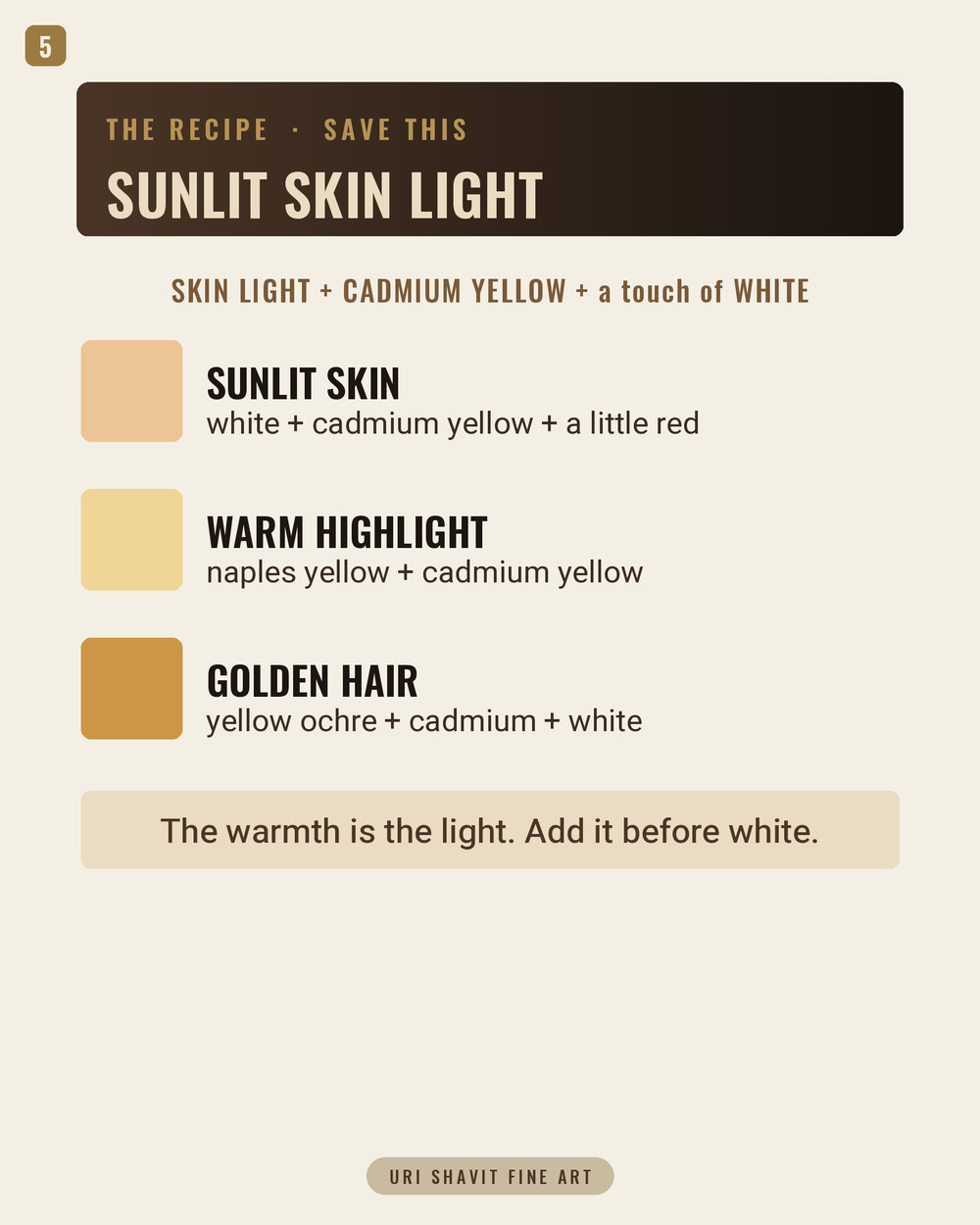
Warm skin light without chalk. Mix cadmium yellow light (PY35) into lead white or titanium white with a small touch of cadmium red or vermilion. The cadmium yellow keeps the light warm and opaque; the red nudges it toward the orange side of yellow that sunlit skin actually sits at. Use far less cadmium yellow than you expect - start with a match-head amount into a generous pile of white and adjust from there. This is the mixture that replaces the flat white highlight. The light will feel like it is radiating rather than sitting on top.
A warm mid-tone that does not go gray. Take yellow ochre as your base, add a small touch of cadmium yellow deep (PY37), and lighten with white. The cadmium yellow boosts the chroma of the ochre without changing its warm, earthy character. This works for the broad lit planes of a face where you need warmth but not the full intensity of the light peak. George Field documented that cadmium yellow mixed with lead white has particular permanence as a combination - worth keeping in mind if you are working for longevity.
A clean, usable green. Cadmium yellow light (PY35) mixed with viridian (PG18) gives a clean, bright green sold commercially as Cadmium Green. This is a warmer, more muted green than you would get from Hansa yellow with phthalo - cadmium's opacity and warm undertone calm the mixture down. For foliage in natural light, or landscape work where you want a green that reads as real rather than fluorescent, that opacity and warmth is exactly what makes the combination useful.
The honest caveat
Cadmium yellow will not give you bright, clean secondaries with organic blues and greens the way a transparent Hansa yellow will. Because it is opaque and has a warm undertone, it produces comparatively muted results when you push it toward vivid violet or pure green. If you need a vivid secondary, Hansa yellows beat cadmium for that specific job. What cadmium yellow gives you instead is opacity, permanence, and the highest available chroma in an opaque yellow - and those three things together are irreplaceable for warm lights in oil.
One more thing: do not assume that because modern cadmium yellow is rated ASTM Lightfastness I, historical cadmium passages in old paintings are fine. The 19th-century versions degraded - fading, darkening, white surface crusts of cadmium sulfate or carbonate - in works by Van Gogh, Matisse, Picasso, Seurat, Munch, and Ensor. Your modern tube is more stable. That is not a small thing. Also: cadmium colors will fade in fresco or lime-based grounds, where alkalinity accelerates carbonate formation that the oil vehicle normally prevents. Keep cadmium yellow in oil on canvas or panel.
Go and do this
Put cadmium yellow next to your titanium white, mix a match-head amount of cadmium into a large pile of white, and paint a single highlight stroke on whatever is in front of you. Then paint the same shape with plain white. Look at both for sixty seconds. The warmth in the first stroke is not decoration - it is the physics of how light falls on a surface. Once you see it, the chalky white highlight stops being an option.
Get the free skin tone cheat sheet. Every mix in this article on one printable page, sent straight to your inbox.
Visit the Color Mixing Book Library for the three books this all comes out of.


Comments