
Indian Red: the Earth Red That Goes Cool

Every earth red on your palette leans warm. Except one - and that one is the reason a cheek can actually turn away from the light.
Every earth red leans warm. Except one.
People reach for earth reds when they want warmth - raw sienna for a glowing ground, light red for a brick-warm underpainting, Venetian red for a ruddy flesh passage. That association is so automatic that painters often treat all the earth reds as interchangeable, just different shades of the same warm family. That assumption will get you into trouble.
Indian red does not lean warm. It leans cool. It sits at the bluish end of the hematite family, and that single fact changes everything about how you use it. The yellowish end of the same family gives you light red and Venetian red - warm, orange-adjacent, exactly what people picture when they think "earth red." Indian red is the other end: darker, denser, with a blue-violet cast that makes it behave more like a muted cool red than like the rest of its relatives. That cool lean is not a limitation. It is the whole point. When a cheek turns away from a warm light source, the halftone does not go more orange - it goes cooler.
What Indian red actually is
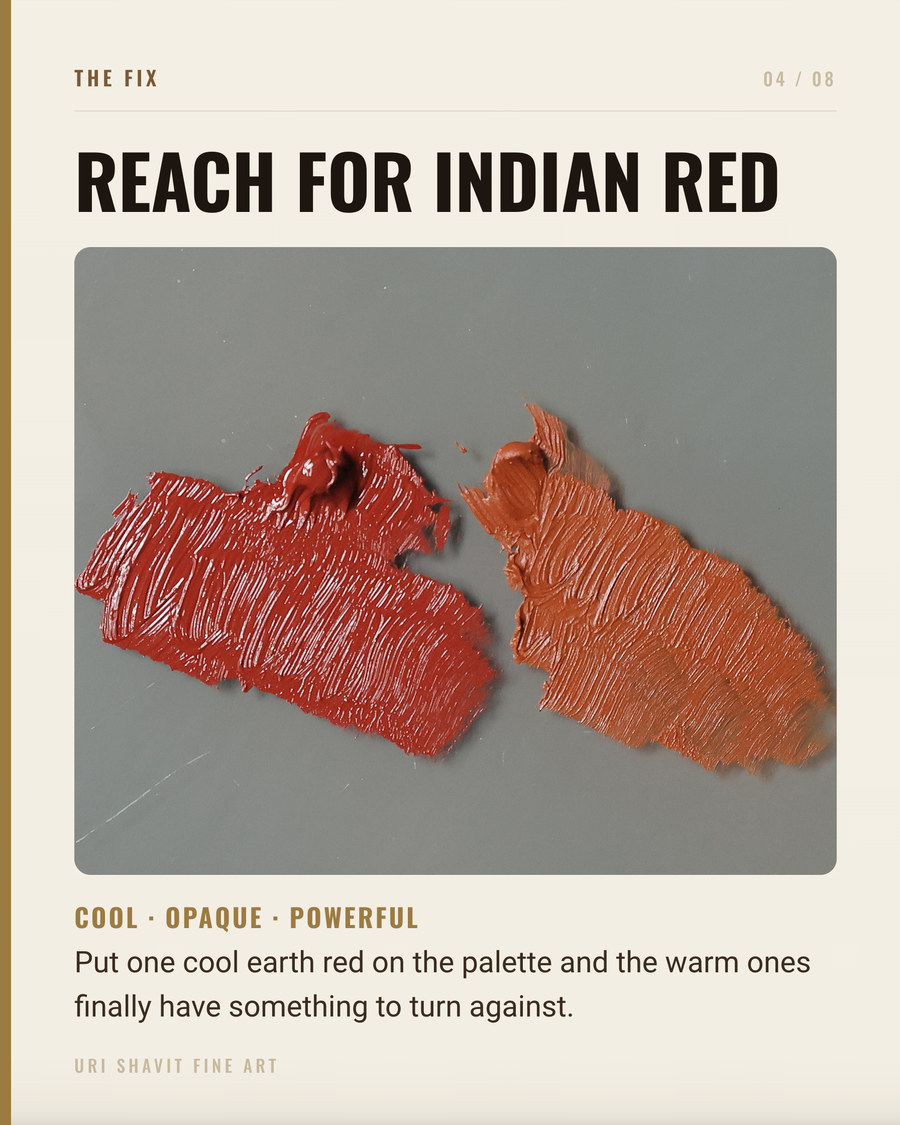
Indian red is anhydrous ferric oxide, Fe2O3, based on the mineral hematite. The "anhydrous" part matters: unlike yellow ochre or the brown ochres, Indian red carries no water locked into its structure. That is what pushes its hue toward the blue-red rather than the yellow-red end of the iron oxide spectrum.
In the Color Index it is listed as PR102 for the natural earth form and PR101 for the synthetic version. Both are iron oxide; both look similar in mass tone. But they are not identical, and I will come back to that in the caveat section - the tube label is the only guide you have.
In oil, the natural pigment handles well. It is fully opaque with above-average tinting strength, so a little goes a long way. It brushes with a slightly "long" quality in the direction of the stroke - pulling smoothly rather than dragging. Oil absorption is moderate, roughly 18 parts linseed to 100 parts pigment, forming a hard, reasonably flexible film. Lightfastness is rated ASTM I - the top rating - though I have seen that figure on manufacturer pages rather than an independent test report I can point to directly. What I can say without reservation is that hematite is among the most stable colorants in human history. Red ochre hand prints made with hematite pigments at Pech Merle in southern France have survived 16,000 to 25,000 years in readable condition. Your painting will outlast any concern about fading.
The historical thread
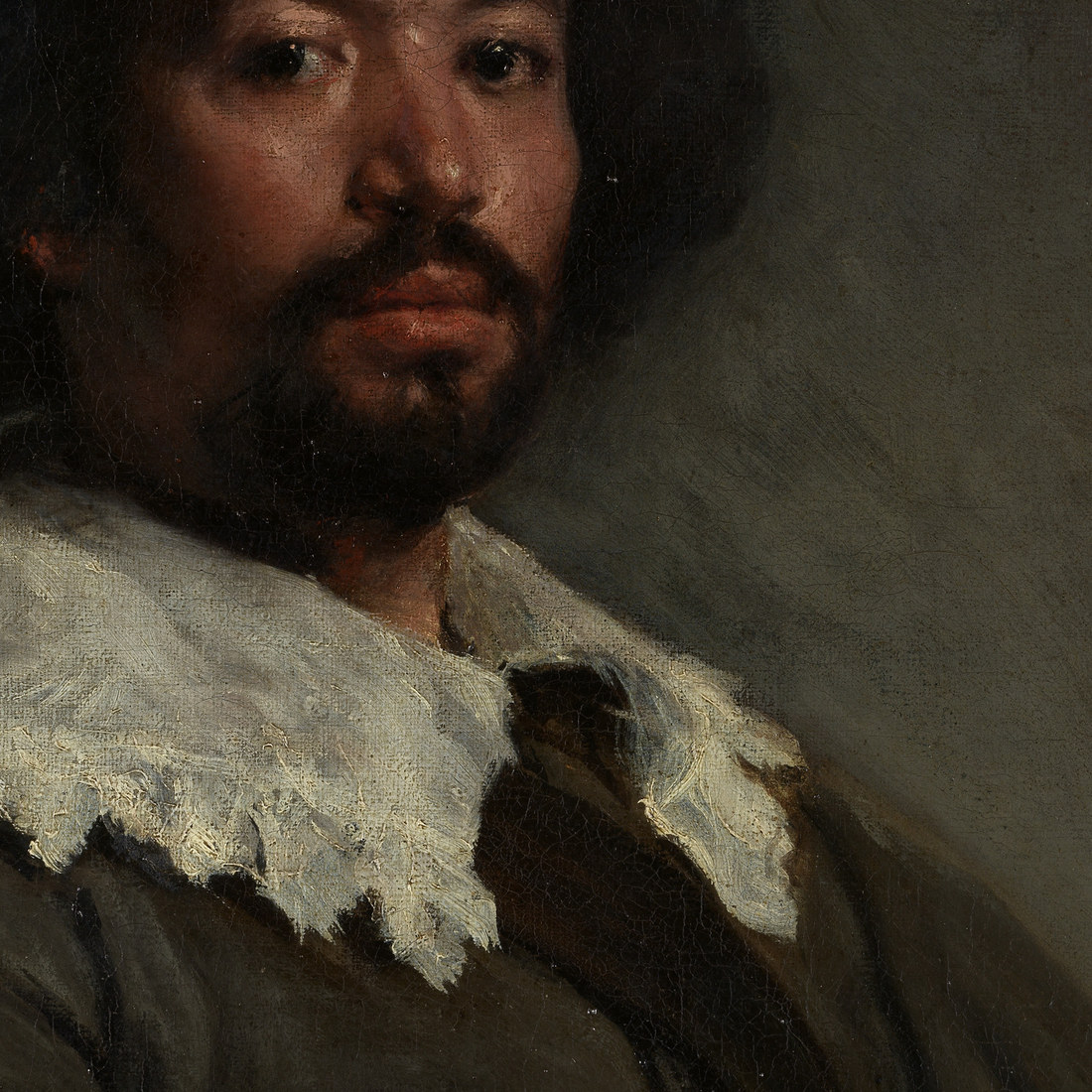
Hematite is as old as pigment gets. The same mineral that stained those Pech Merle hand prints was used by every major civilisation that followed. By the time European painters were building their palettes in the 15th and 16th centuries, red iron oxides were simply a given.
The specific name "Indian red" arrived in English in 1672, applied to red earths imported from the Persian Gulf - particularly from Hormuz - and from India. The most prized material came through that Hormuz port, and the Persian red had been the dominant iron oxide red across the Middle East for centuries before European traders gave it a label. By the early 18th century a synthetic version, made from steel mill wastes, was already in production, widening access and gradually shifting trade away from the imported earths. Diderot's Encyclopedie of 1765 treated Indian red and English red as near-synonyms, which tells you how confused the nomenclature had already become.
The honest summary: the pigment is ancient; the name is 17th century; the synthetic version is 18th century and later. Painters who used cool dark reds before the name existed - Velazquez, Rembrandt, and others - were working with natural hematite earths in a general sense, not with the specific traded import that later took the Indian red label.
The failure modes
Overloading the flesh mixture. Indian red has strong tinting power and full opacity. Because its mass tone in the tube is so dark, beginners consistently add more than they need, trying to get the color to "show up." The result is a flesh tone that looks bruised or livid - dirty rather than warm. Start with a fraction of what you think you need, mix thoroughly, and judge from there before adding more.
Pairing it with too much titanium white. Titanium white is already a powerfully opaque pigment. Combine it with the full opacity of Indian red and the resulting tint goes chalky and flat almost immediately. If you are mixing flesh lights with Indian red in them, either reduce the titanium and introduce a transparent pigment, or use a titanium-zinc white blend, which produces noticeably less chalky results.
Trusting the name and ignoring the code. PR102 is a natural earth; PR101 is a synthetic iron oxide. Tubes from different brands all say "Indian red" on the label. But a PR101 tube and a PR102 tube handle differently and carry slightly different undertones - the synthetic is engineered for consistency; the natural earth brings more working variation and subtle character. Check the index on the back of the tube, not the name on the front.
The three mixes that matter
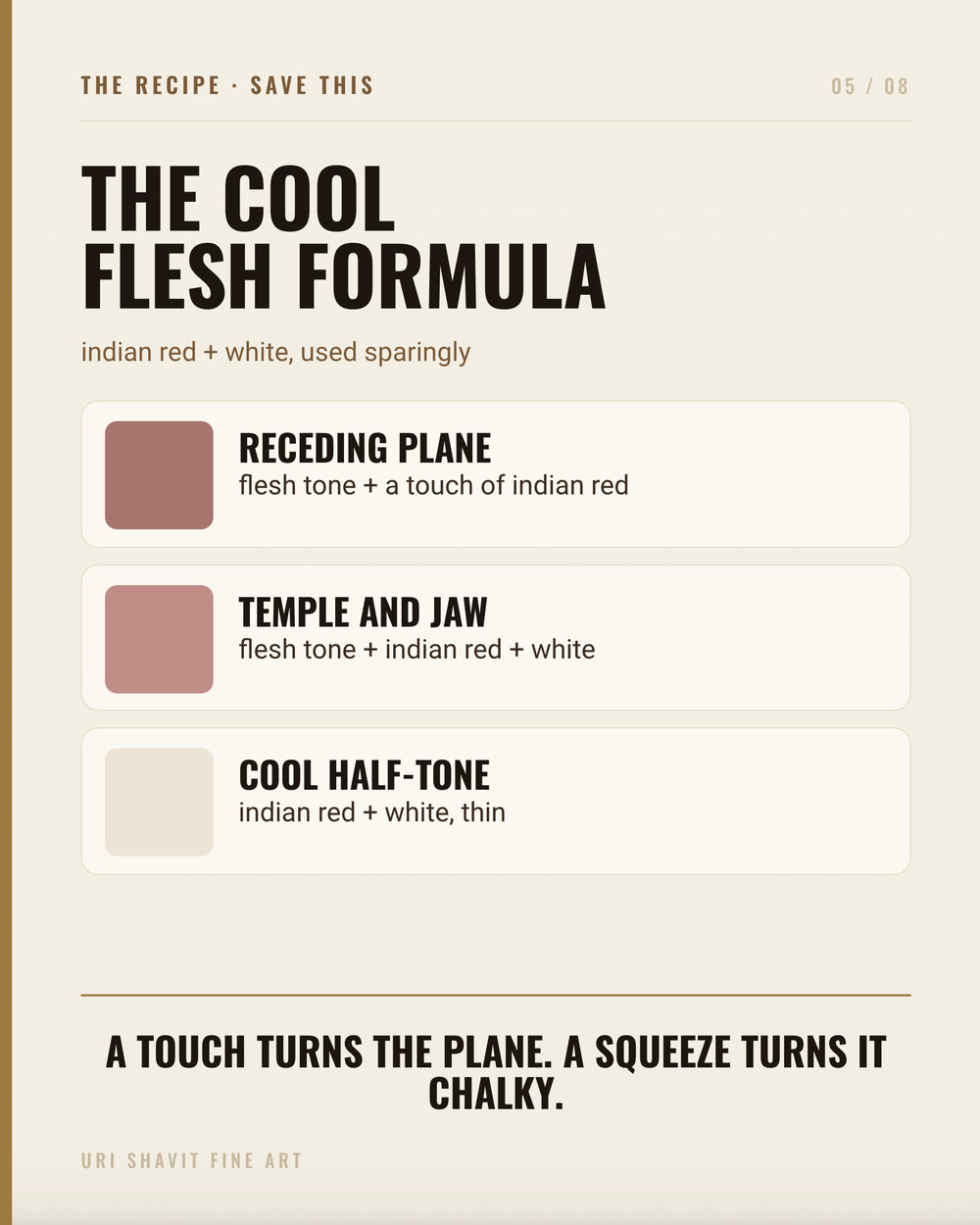
Indian red and zinc white for the turning plane. This is the mix Indian red was built for. Zinc white is more transparent than titanium, which keeps the tint from going chalky, and the resulting dusty rose sits in exactly the value and temperature range where a cheek or brow ridge begins to turn away from the light. Push cadmium red or vermilion into the light passages; keep this mix for the halftone. The contrast in temperature reads as three-dimensional even before you model with value.
Indian red and viridian for low-chroma shadow. Indian red is a cool red; viridian is a cool green; they sit close to complementary. Mixed together they produce a muted neutral that is neither warm nor cold - right for deep shadow passages where you do not want the shadow to read as a color. Because Indian red has strong tinting power, keep it the minority component and build up slowly. Too much Indian red and the mix tips toward a muddied flat gray.
Indian red and madder lake for Tuscan red. This is a historical compound that still earns its place. Historical recipes called for roughly nine parts Indian red to one part madder-based lake; a four-to-one ratio gives a slightly more vivid result worth trying. The madder adds transparency and a richer red cast; the Indian red provides stability and body. What is worth knowing is that madder lake mixed with Indian red fades significantly less readily than madder used alone or with ochre or sienna - a useful property if you are working any rose madder or alizarin into flesh passages.
The honest caveat
Indian red will not give you a warm red. If you are hoping to push a flesh tone toward heat, you are using the wrong pigment - that is light red's job, or cadmium red's. Indian red cools and darkens; it does not warm and brighten.
Some manufacturers sell a tube labelled "Indian red hue" built from non-earth synthetic pigments with no iron oxide in them at all. That tube is not this pigment. And even within genuine Indian red, PR101 and PR102 are different materials. Check the index. A few seconds reading the back of the tube will save you a ruined flesh passage.
Go mix it
Pull out whatever white you have and mix a small strip of Indian red from full strength down to a pale tint. Then do the same test with light red or Venetian red and hold the strips side by side. The difference in temperature between the two families is the whole lesson. Once you have seen it, you will know immediately which one to reach for when a plane turns away from the light.
Get the free skin tone cheat sheet. Every mix in this article on one printable page, sent straight to your inbox.
Visit the Color Mixing Book Library for the three books this all comes out of.


Comments