
Light Red: the Earth Red That Warms a Shadow Instead of Killing It

Skin shadows are not gray. They are red - and this ancient pigment is how painters have known that for 25,000 years.
The myth on the tube label
Let's start with something people get wrong constantly: skin shadows are not gray. I see it on portraits all the time - a cheekbone rolls into shadow and suddenly the color goes cool and desaturated, as if someone swapped out the light source for a fluorescent bulb. It looks wrong because it is wrong. Skin cools slightly in shadow, yes, but it does not go gray. The blood is still running. The warmth is still there. If you reach for a neutral gray to drop those shadows, you will flatten the face into something that looks more like a diagram than a person.
The second myth is the one on the tube label. Light red sounds like a pale, washed-out crimson. It is nothing of the sort. It is a dense, opaque, warm brick-orange that has been in painters' hands for longer than any civilization has existed. The name tells you almost nothing about the pigment. So let me tell you what actually matters.
What light red actually is
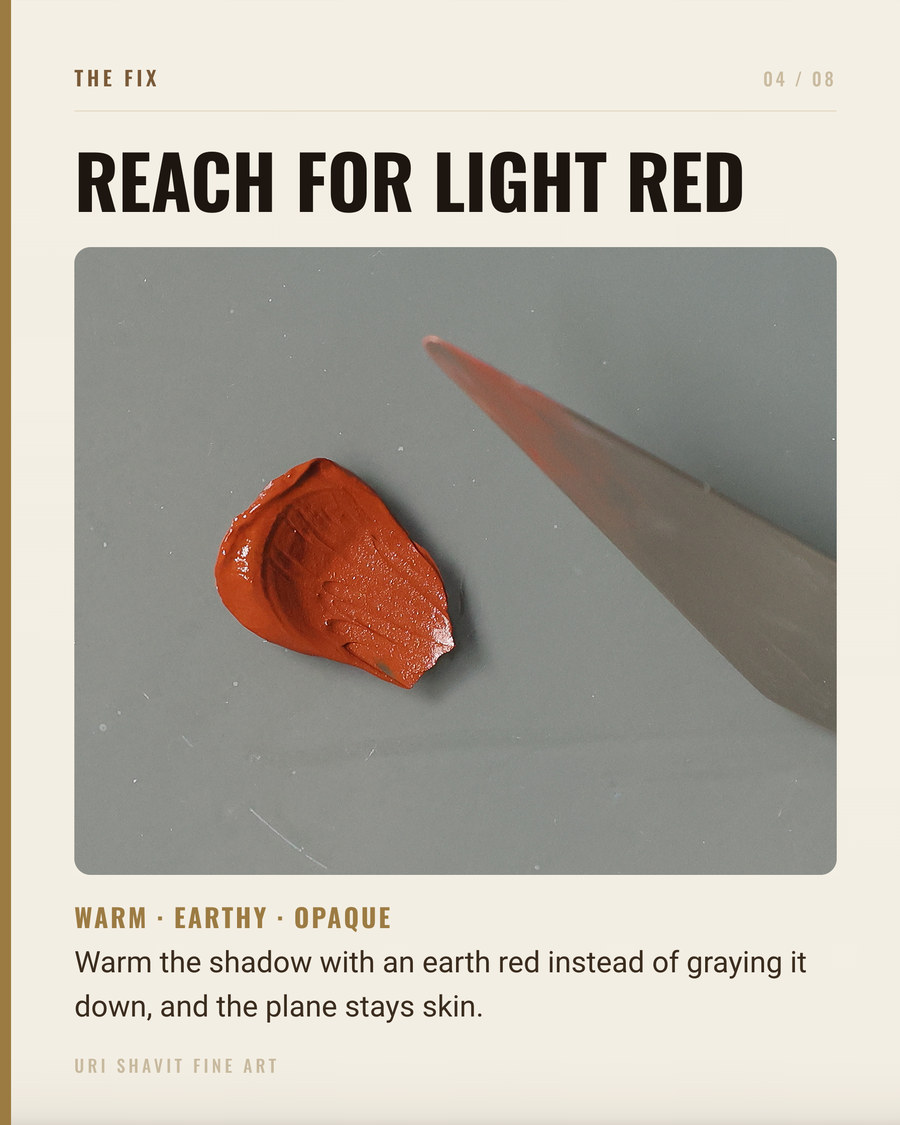
Light red belongs to the red ochre family. Its Color Index designation is PR102, and the chemistry is straightforward: the coloring agent is hematite, anhydrous iron oxide (Fe2O3). What separates light red from its close relatives - Indian red, Venetian red, English red - is color bias. The yellowish or orange-red shades of red ochre carry the light red name; the bluish, cooler shades are Indian red. ASTM standard D 4302 codifies this distinction, so it is not just marketing - it is a technical specification.
In oil, light red is opaque and covers well. It has above-average tinting strength, which matters enormously in practice - a small quantity shifts a white tint strongly toward salmon or terracotta, and painters who underestimate this end up over-driving flesh mixes into brick territory they cannot walk back. Oil absorption is low to moderate. It dries at a medium rate, roughly two to five days to touch-dry, and forms a hard, fairly flexible film. Lightfastness is ASTM I - the top rating - matched by a Blue Wool scale rating of 8 out of 8. PR102 is a natural earth, meaning it is a multi-phase mineral system with variable particle geometry and surface chemistry. That variability is part of its character, and it also means two tubes labeled "light red" from different manufacturers can handle quite differently.
Where light red comes from

Here is the honest historical situation with light red: there is no predecessor to name. With cobalt blue, I can tell you it displaced azurite. Light red has no such story because it is the original red. Hematite-based red pigments have been found in cave paintings in France dating to 16,000-25,000 BC. Worked ochre is present in deposits at Pinnacle Point Cave in South Africa dating to roughly 164,000 years ago. The pigment did not arrive at some point in art history - it was already there before art history had a name.
What changed over time was refinement. Light red as a calcined material - red ochre produced by roasting yellow ochre at around 500-600 degrees C for roughly fifteen minutes - has been a deliberate studio practice since at least the 17th century. Roger de Piles described what he called "brun rouge" - labeled variously rouge Anglais, light red, burnt ochre, and brown red - as a natural iron oxide earth. The naming confusion is ancient and is not a modern problem. By the 19th century, synthetic red iron oxide (Mars Red, PR101) was lab-produced and found to share the same durability as the natural earth, which is where the tube-label trap enters.
The failure modes
Buying PR101 when you think you are buying PR102. Several manufacturers sell synthetic red iron oxide under names like "Venetian Red" or "Iron Red Light" - Gamblin, for example, describes its Venetian Red as "formerly called Iron Red Light" and lists it as PR101. Synthetic iron oxides are engineered for uniformity; the natural earth retains the subtle variation of its mineral origin. The two behave differently in paint. The fix is simple: read the Color Index number on the tube, not the marketing name.
Overloading flesh mixes. Light red's tinting strength catches painters off guard. Artists used to transparent organic reds apply light red by the same generous logic and end up with brick-pink passages that resist every correction. The solution is to pre-mix a pale tint of light red into white before it touches the flesh mix - controlling the dose before it enters the pool, not chasing it afterward.
Jumping across palette neighbors. On the classic Old Master earth palette - white, yellow ochre, green earth, sienna, red ochre, umber, black - Roger de Piles' rule still holds: mix only with neighboring colors or with white. Mixing light red directly into black without umber as a bridge does not give you a dark warm red. It gives you a dead, lifeless passage. The palette sequence is the mixing map.
The three mixes that matter
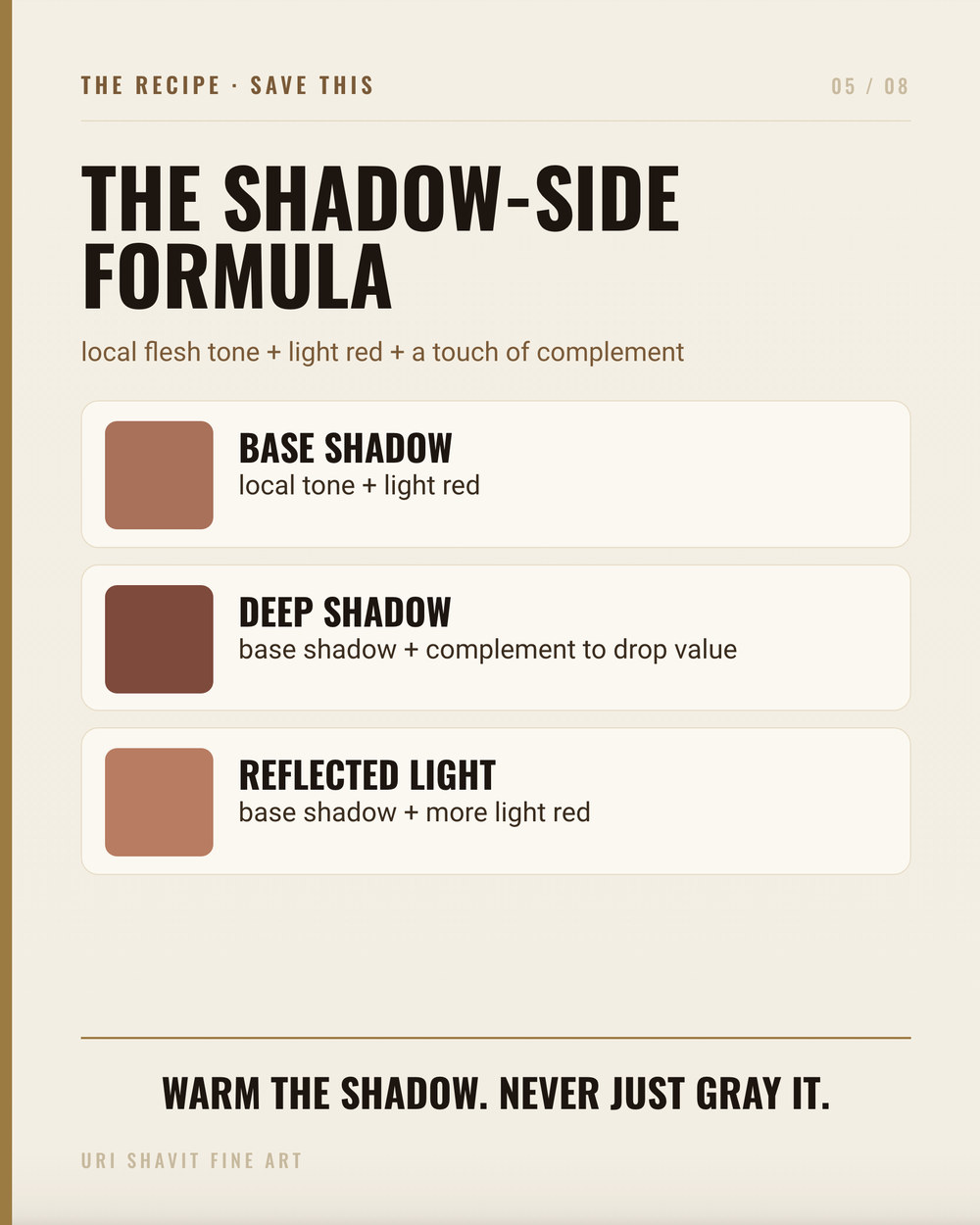
The shadow flesh anchor. Raw umber with a small addition of light red, then value adjusted with white rather than more pigment. This keeps the shadow warm and chromatic without tipping into orange. The Palette Behind the Masters is specific about this construction: the shadow structure in its plate studies is built on exactly this umber-ochre pair, with red earth carrying the warmth and umber providing the depth and slight green-gray lean that reads as shadow rather than sunburn.
The salmon-pink mid-tone tint. Light red mixed into titanium white at roughly a 1:10 ratio produces a warm salmon useful for the mid-tone zones between light and shadow on a fair complexion. Pre-mix this as a separate pile on your palette - squeeze a small amount of light red, add a large pile of white, and work them together until you have a pale, just-warm tint. Bring that tint into the flesh color rather than adding raw light red directly.
The warm neutral for reflected light. Mix light red with its complement - a blue-green such as cerulean or a muted viridian - and add white to lift the value. The result is a range of warm neutral tones that read as reflected light on the shadow side of a face without going lavender or cold. Iron oxides make excellent naturalistic grays when paired with their complement, and this pairing stays on the warm side of neutral, which is where skin shadow actually lives.
The honest caveat

Light red will not give you a transparent, jewel-like red. In mass tone it is opaque and covering; in thin films it becomes a warm scumble rather than a true glaze. If you need deep, luminous transparent red, light red is not the tool. Use it for structure, for warmth, for the flesh mixes where you want an earth relationship with the color. And always check the Color Index: PR102 is the natural earth; PR101 is the synthetic equivalent. Both are permanent, but they are not identical in handling, and you should know which one is in your tube.
What to do next
Pull out whatever red earth you have in your box - light red, Venetian red, Indian red, burnt sienna - and check the Color Index number on the label. Then do one thing: pre-mix a pale tint of white and light red, set it on your palette, and spend a session dropping that tint into every shadow zone of a portrait instead of a gray. Notice whether the face stays alive. That single substitution - warm red earth for cool gray in the shadows - is the foundational move of a portrait palette, and it has been the move since before painting had a name.
Get the free skin tone cheat sheet. Every mix in this article on one printable page, sent straight to your inbox.
Visit the Color Mixing Book Library for the three books this all comes out of.


Comments