
Permanent Alizarin Crimson: the red that is already leaving your painting

Why portrait painters use alizarin crimson in exactly the application where it fades fastest - and what the permanent swap actually means.
Your crimson is already leaving
People say: "I use permanent alizarin crimson, so I'm fine." I understand the logic - the tube says "permanent," so the problem is solved. But here is what nobody tells you: "permanent alizarin crimson" is not a single thing. It is a marketing category. Two tubes from two different makers can contain completely different pigments with different transparencies and different glazing behavior. The word "permanent" on the label is a promise about lightfastness - it says nothing about what is actually inside.
And the original alizarin crimson, PR83, is still one of the five best-selling artist colors on the planet. It is still on your supplier's shelf. Its name is on the corners of paintings that will not look the same in thirty years. So before we talk about the permanent version, we need to understand what painters are actually replacing.
What permanent alizarin crimson actually is
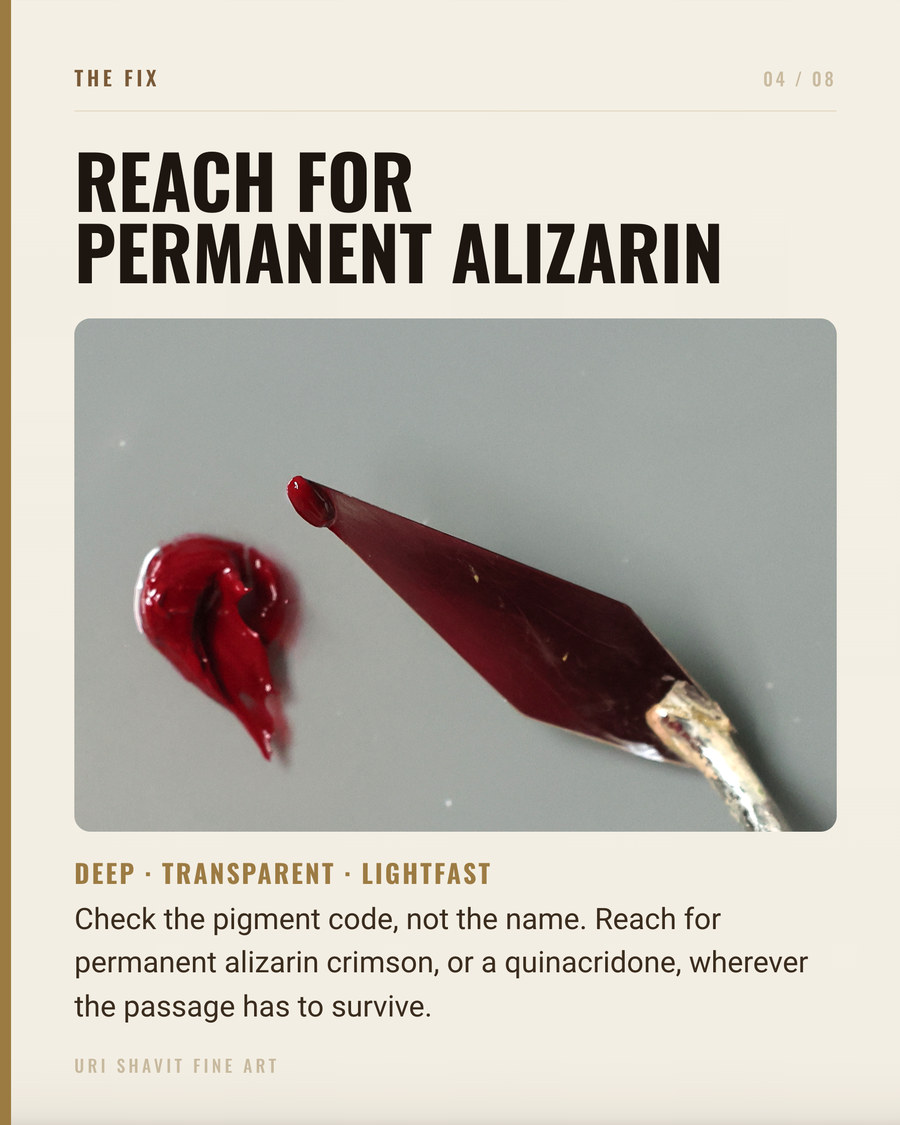
The most widely sold single-pigment "permanent" version uses PR177, anthraquinone red. Gamblin Artists Colors uses it for their Alizarin Permanent: a cool, slightly bluish red, transparent in oil, rated ASTM Lightfastness I. Gamblin describes it as an excellent match for PR83 in masstone, transparency, and tint.
What painters do not always realize is that Gamblin also makes a Conservation Colors version of Alizarin Permanent that is not PR177 at all - it is a mixed-pigment formula combining Quinacridone Red, Ultramarine Blue, and Perylene Red, all Lightfastness I pigments, developed in the 1990s to replace the fugitive PR83. Two products, same name, different contents.
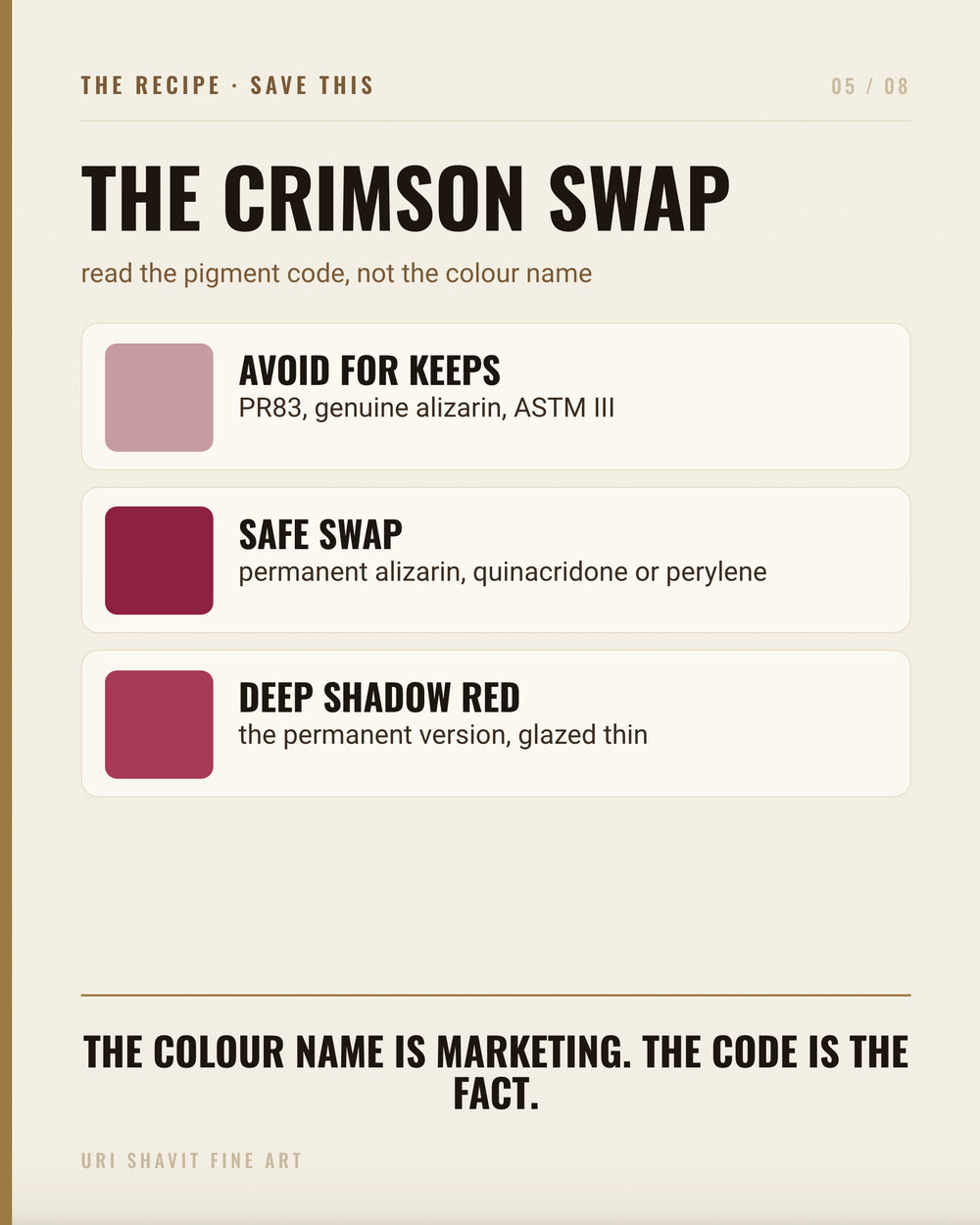
The pigment they replace is PR83: synthetic 1,2-dihydroxyanthraquinone precipitated on alumina - a lake made by fusing a dye onto a substrate. It carries ASTM Lightfastness III in oil, meaning fugitive. In practical terms, PR83 can fade within months under strong light. Crucially, its worst fading happens in tints - in mixtures with white. The ASTM III rating is measured in a tinted drawdown at 40% reflectance with titanium white. That means the standard test shows you exactly what happens in a flesh mixture or a pale rose, and the answer is: it fades there first.
PR83 is a beautiful pigment - very transparent, bluish-red, darker and warmer than quinacridone red, fine grain, high tinting strength. It absorbs roughly 100-120 grams of linseed oil per 100 grams of pigment, dries slowly, and requires many passes to grind properly. It is genuinely seductive to paint with. I understand why it sells.
Where this red comes from

The story begins with madder root, Rubia tinctorum. Madder has been cultivated since antiquity - cloth dyed with it was found in Tutankhamun's tomb and in the ruins of Pompeii. By the seventh century BC, craftsmen had turned the dye into a lake pigment usable on a surface. In 1826, the French chemist Pierre-Jean Robiquet established that madder root contained two colorants: alizarin and the more rapidly fading purpurin. In 1868, Karl Graebe and Karl Liebermann at BASF synthesized alizarin from anthracene. William Perkin in England reached the same synthesis independently, but the BASF group filed their patent one day earlier. Synthetic alizarin cost less than half the price of the natural product. The madder cultivation industry collapsed almost overnight.
Synthetic PR83 is a lake of that synthesized alizarin dye precipitated onto aluminum hydrate - the direct successor to natural rose madder on the painter's palette. The quinacridone pigments developed at DuPont in 1958 are more lightfast, and they have largely replaced alizarin in professional practice - yet PR83 remains a top-five seller. That tells you something about how strongly painters are attached to this color's particular character.
The three ways painters get this wrong
The first failure mode is treating the permanent version as a drop-in swap without testing. PR177 is a close match, but the mixed-pigment Conservation Colors version can be slightly less intense in transparency. In a thin glaze - the exact application where alizarin earns its reputation - the two can read differently. Do a simple drawdown: a stripe of each version thinned with medium over a dried swatch of white underpaint. Look at both in natural light before committing to a painting.
The second failure mode is mixing PR83 with raw earth pigments. Alizarin is fugitive when mixed with raw ochre, raw sienna, or raw umber - chemical interaction with unburnt iron pigments alters it and accelerates fading. The burnt versions - burnt sienna, burnt ochre, burnt umber - do not cause this problem. Maximilian Toch noted in 1911 that the lake should be used as a pure glaze over a thoroughly dry surface rather than blended wet-into-wet with mineral pigments. That observation holds for PR83 and its permanent stand-ins alike. Painters who freely mix alizarin into flesh tones alongside yellow ochre or raw sienna are accelerating the very fading they want to avoid.
The third failure mode is using PR83 in opaque tinted mixtures to modify flesh or mix pale roses. This is precisely the application the ASTM III rating is testing. Portrait painters reach for alizarin in the lights - to warm a cheek, push a lip into pink, cool a shadow with a blue-red. Those are all tinted mixtures, and those passages fade first. If you are working with flesh tones and using PR83 to tint, use the permanent version there, without compromise.
Three mixes that matter
The vermilion glaze for deep cherry red. Model the form first in cadmium red or vermilion with titanium white and a small amount of bone black. Let it dry completely. Then glaze over it with permanent alizarin crimson thinned with a resin medium. Vermeer used this two-layer structure - opaque warm red underneath, transparent red lake on top - to achieve a depth of red impossible by direct mixing. It only works as a true glaze over a dry surface. Wet-into-wet gives you mud.
The warm flesh shadow. Mix burnt sienna with a small amount of permanent alizarin crimson and a touch of ultramarine blue to neutralize. Burnt sienna is safe with alizarin; the ultramarine deepens without shifting the hue too far violet. Keep the mixture lean and transparent. This is not a body-color mixture - it is a shadow glaze that lets the underpaint read through it.
The permanent violet. Mix permanent alizarin crimson (PR177) with ultramarine blue. The point is the word "permanent." If you make this same mix with PR83, you are making a fugitive violet - within a hundred years it will be blue, not purple, because the red will have faded and the blue will remain. PR177 with ultramarine gives you a cool, transparent violet that will outlast everything on the canvas. It is one of the most useful darks in a portrait palette.
The honest caveat
No version of permanent alizarin crimson will do everything PR83 does. The specific chroma of PR83 in a thin glaze - that smoky, slightly warm bluish transparency - is difficult to replicate exactly. When neither the PR177 formula nor the mixed-pigment version closes that gap, the best single substitute is quinacridone red (PV19). It has higher chroma in transparency and can be grayed slightly with a small amount of transparent green or a touch of carbon black to approximate the PR83 effect. It is not identical. But it is permanent, and after thirty years it will still be there.
One more thing: madder lake and its synthetic descendants deepen in darkness and appear to recover somewhat in bright light. A painting that looks faded in storage may look less so in exhibition. Do not use this as a reason to keep PR83 - it is still fugitive - but it is useful when you are trying to read what an old painting once looked like.
What to do next
Pull out your tubes of anything labeled "alizarin crimson" and read the pigment index. If it says PR83, you know exactly what you have and exactly where it will fail you. If it says PR177, test it in a thin glaze before you put it on a painting you care about. If it lists a mixture of quinacridone red, ultramarine, and perylene red, that is the Conservation Colors approach and it is a solid choice. What you should never do is assume the word "permanent" on the label has already solved the problem. The label is a start. The pigment index is the answer.
Get the free skin tone cheat sheet. Every mix in this article on one printable page, sent straight to your inbox.
Visit the Color Mixing Book Library for the three books this all comes out of.


Comments