
Chrome Yellow: The Bright That Quietly Turns Brown

What Van Gogh's sunflowers can teach you about a pigment that lies in slow motion.
The yellow that doesn't stay yellow
People say chrome yellow is the yellow of the Impressionists - warm, sunny, expressive. And it is. But here is the part nobody mentions until twenty years later: that bright yellow has a slow chemical secret. It doesn't fade toward white. It darkens. Brown. Sometimes green. And the change happens inside the paint film, not on the surface, so no amount of cleaning or revarnishing will fix it.
Van Gogh knew his yellows were at risk. Renoir reportedly called chrome yellow's behavior "nasty tricks." These were painters who lived with the problem in real time. So before you reach for anything with the word "chrome" on the label, let me tell you exactly what is in it, what it does, and whether the modern version actually solves the problem.
What chrome yellow actually is
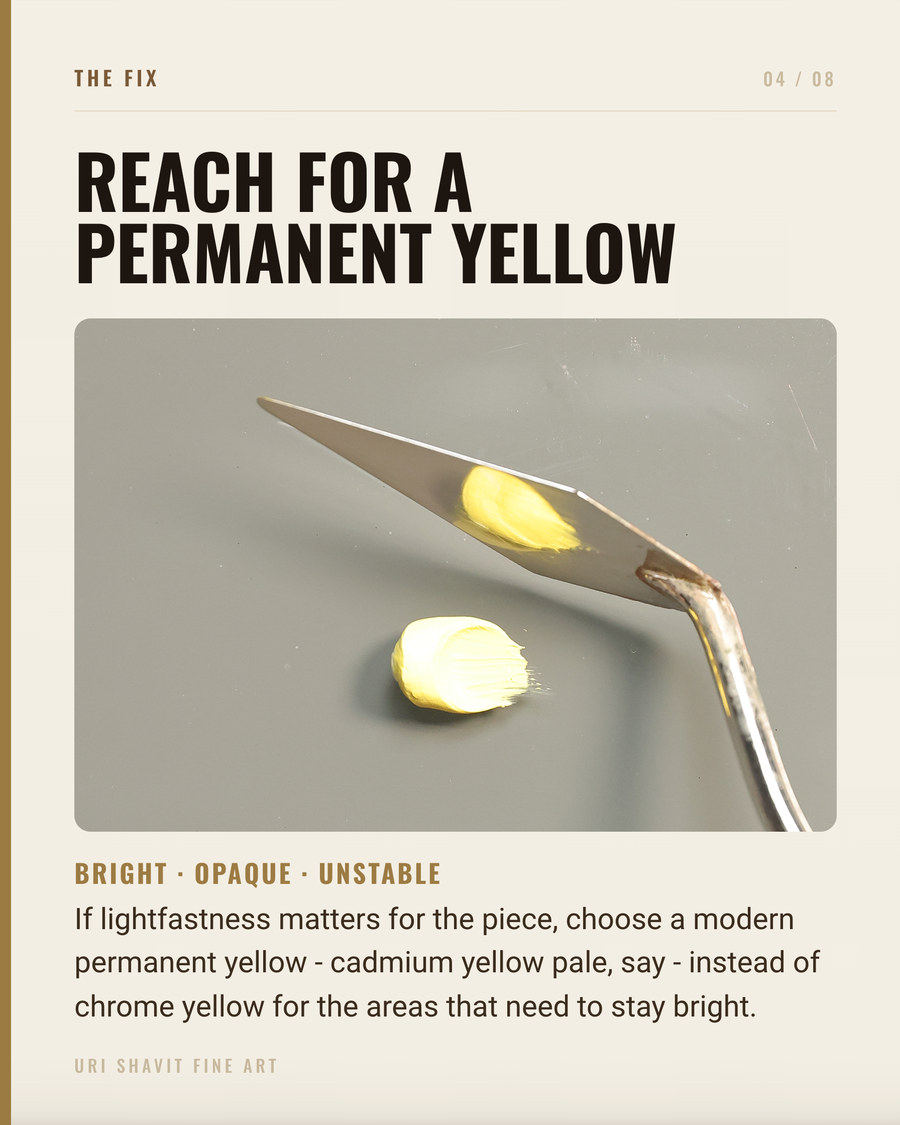
Chrome yellow is Pigment Yellow 34 (CI 77600), a lead chromate - PbCrO4. The primrose shades are lead sulfochromate, meaning part of the chromate is replaced by sulfate, shifting the crystal form and lightening the hue. Medium chrome is pure monoclinic lead chromate; primrose is rhombic. Shade, crystal structure, and sulfate content all change together.
In oil, the behavior is distinctive. Lead chromate has a refractive index of 2.3 to 2.7, giving it strong hiding power. Its oil absorption is very low - 16% to 27% across the family - which means a densely loaded paint that brushes out long and flowing while still holding a mark. The stroke stays where you put it. That combination of flow and mark-holding is unusual and is exactly the quality the Impressionists were exploiting in those thick, directional strokes.
The lightfastness is where the trouble lives. No source I found gives unencapsulated chrome yellow a specific ASTM rating - what you get is the word "moderate," which in pigment terms should make you cautious. Modern silica-encapsulated chrome yellow is a different product: the silica shell blocks the photochemical and chemical pathways that cause darkening. But encapsulated chrome is not what most painters have in their cabinet.
Chrome yellow is also toxic - lead and hexavalent chromium together make it a carcinogen, teratogen, and suspected mutagen. Handle it accordingly.
Where it came from and what came before it
Chromium was first isolated from the Siberian mineral crocoite by the French chemist Nicolas Louis Vauquelin in 1797. He published the preparation of synthetic lead chromate in 1809. Commercial production began in 1818 and spread as chromite deposits were discovered in France, the United States, and Britain.
Chrome yellow is strictly a post-1809 pigment. No painter before the nineteenth century had access to it. The opaque bright yellows before it were orpiment (arsenic sulfide, ancient, highly toxic, and incompatible with lead pigments), lead-tin yellow (used by Titian, Vermeer, and Velazquez, but vanished from use by around 1750 and not chemically rediscovered until 1941), and Naples yellow - lead antimonate - which filled the gap until chrome yellow arrived. Chrome yellow displaced both Naples yellow and orpiment at the commercial level.
One of the earliest known appearances of chrome yellow in a painting is a work by Sir Thomas Lawrence from 1810. By mid-century it was everywhere: Turner, Manet, Cezanne, Monet, Pissarro, Van Gogh, Gauguin. It cost one shilling per watercolor cake in 1835 - cheap, opaque, and powerful. Its popularity declined as cadmium yellow arrived in the mid-nineteenth century, but low cost kept it in circulation even as more permanent options appeared.
How painters misuse it
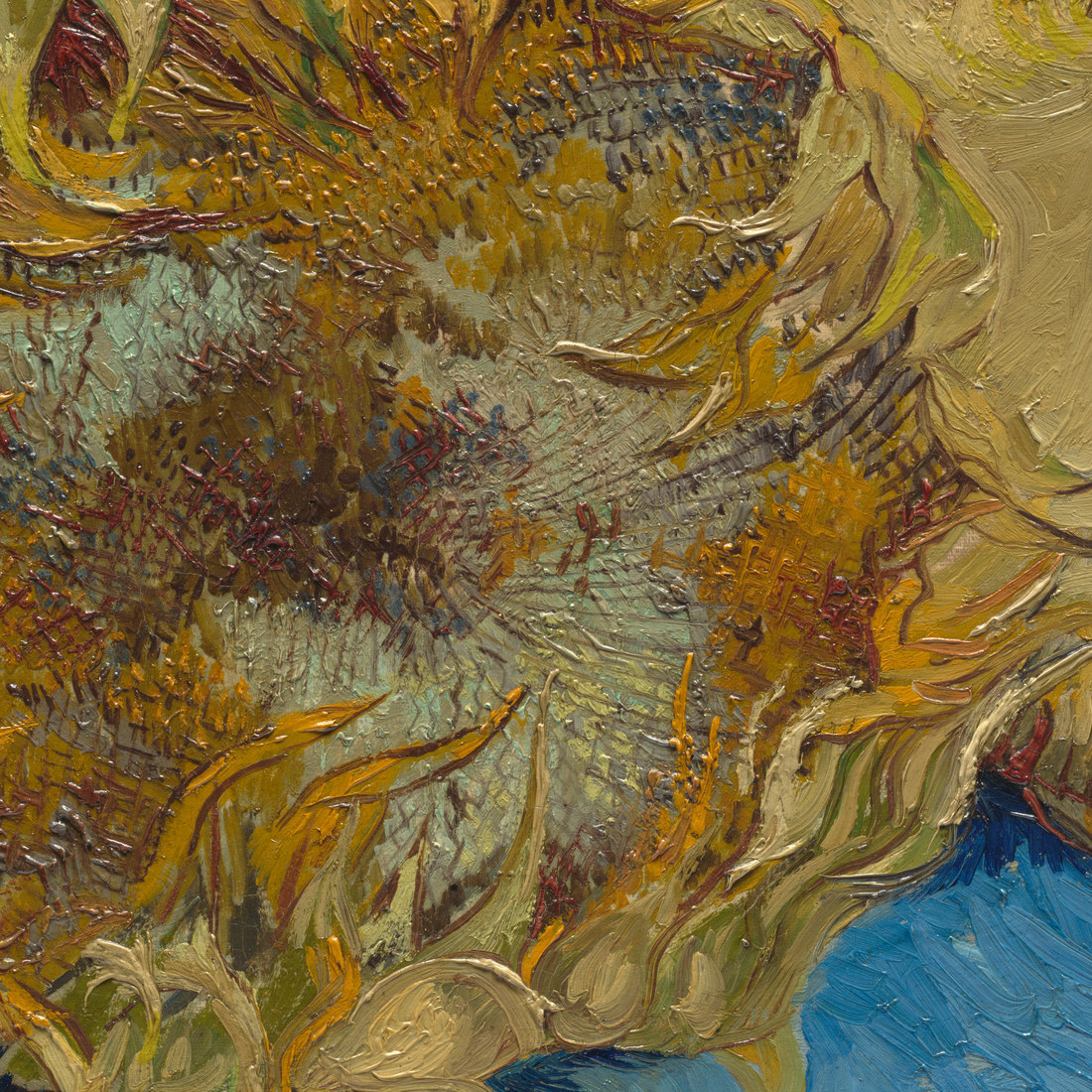
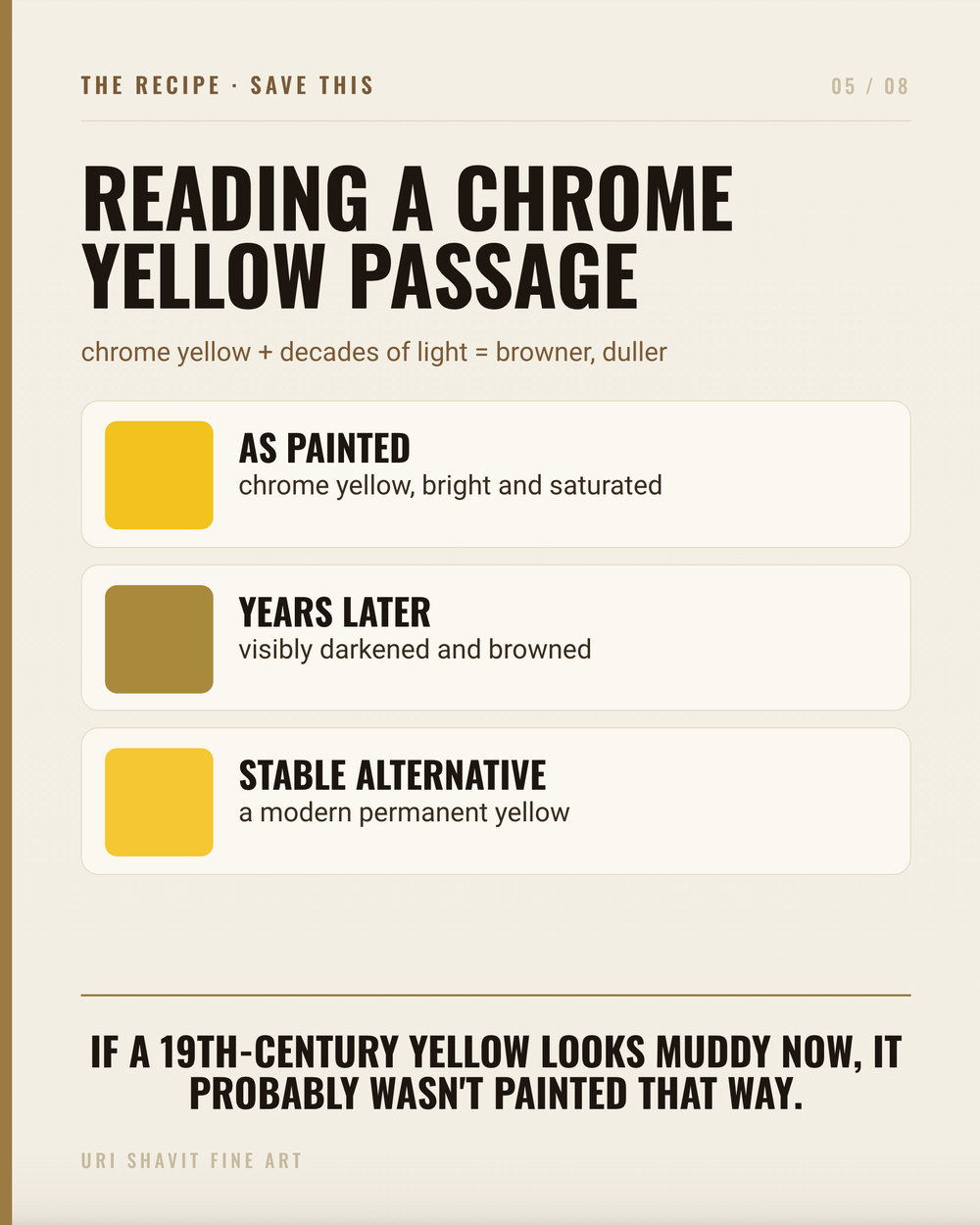
Treating it as permanent without checking what they bought. Unencapsulated chrome yellow darkens by two mechanisms: photochemical reduction from UV exposure, and chemical reduction when it contacts organic pigments, converting hexavalent chromate to chromium(III) oxide - which is green. This is documented in Van Gogh's Sunflowers series by synchrotron X-ray research. The change cannot be reversed. A painter who uses unencapsulated chrome yellow for warm sunlit passages will find those passages shifting toward brown or olive over decades.
Mixing it with sulfur-bearing pigments. Lead chromate reacts with hydrogen sulfide to form lead sulfide, which is black. Chrome yellow is chemically incompatible with any sulfide-based pigment. In practice, mixing it with cadmium yellow (cadmium sulfide) or using it alongside degraded ultramarine - which can off-gas sulfur compounds - accelerates darkening. Chrome pigments also have poor alkali resistance, so painting into a fresh lead-white ground that is still alkaline can shift the mixed color before it dries.
Assuming "chrome yellow hue" handles the same way. Most manufacturers today sell an organic yellow - arylides (PY65) or isoindoles (PY110) - under the name "chrome yellow hue." These are safer and more lightfast, but they lack the opacity, brushing length, and mark-holding quality of genuine lead chromate entirely. If you expect that dense, flowing, impasto-ready behavior and buy a cheap hue version, you will not get it.
Three mixes that matter
Primrose against deep chrome for optical yellow depth. Van Gogh's approach in the Sunflowers was not to use a single yellow but to place different shades of chrome yellow side by side - the cooler primrose in the pale outer petals, the warmer deep chrome in the curling inner ones. If you have both shades, use temperature variation between them to model form, rather than dulling one down with a neutral. The result has an optical vibration a single mixed tone cannot replicate.
Chrome yellow, ultramarine, and vermilion for colored grays. Cezanne, Pissarro, and Monet all used this three-primary combination to produce colored grays in a plein-air key. Chrome yellow's high tinting strength and opacity made it effective here: a small amount cancelled chroma without muddying the mix toward black. If you are working with the encapsulated modern version, this three-primary approach for modeling light passages in landscape is the most historically documented use of the pigment.
Chrome yellow alone as the lightest light, without white. Because chrome yellow's oil absorption is so low and its hiding power so strong, it can serve as its own opaque light in small passages without white. Adding white to a warm yellow cools it and reduces chroma. Leading with pure chrome yellow and only touching white at the very lightest edge keeps the note warm all the way through - the quality that made it a welcome alternative to Naples yellow for sunlit effects.
The honest caveat
If you are buying chrome yellow today, the most important thing is not the name but the pigment code. PY34 is genuine lead chromate. If it is not encapsulated, treat it as historically interesting but impermanent: useful to study, not something to build lasting work around. Encapsulated PY34 from specialist suppliers such as Natural Pigments is a genuinely different product with documented chemical resistance - but it is not widely stocked and is not what you find in most art supply shops.
If the tube says "chrome yellow hue" and lists an organic yellow, you have a safe, lightfast paint that handles nothing like the original. That is not a criticism - it is a description. Know which one you are buying before you decide how to use it.
Go check your yellows
If you have paintings older than ten or fifteen years with passages mixed from a yellow labeled "chrome," look at them under good light. If those passages have shifted toward olive or brown, you now know why. The change is not the varnish yellowing and it is not the support moving - it is the pigment itself.
For new work the decision is simple: if you want that dense, flowing, mark-holding yellow in the warm range, find encapsulated PY34 from a specialist supplier and treat it with the care a lead-bearing pigment deserves. If you want a safe warm yellow that approximates the hue, a good cadmium yellow or isoindoline yellow will serve you better than a hue tube that promises the name but not the behavior. The pigment's history is extraordinary. But a yellow that quietly turns brown is not doing you any favors, and knowing that is the whole point.
Get the free skin tone cheat sheet. Every mix in this article on one printable page, sent straight to your inbox.
Visit the Color Mixing Book Library for the three books this all comes out of.


Comments